
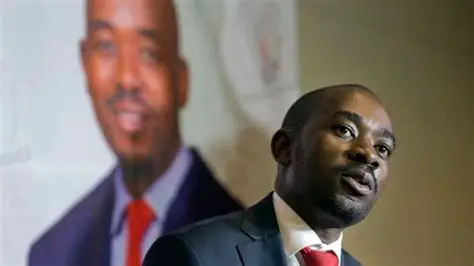
The Chamisa Cycle: A Lesson Zimbabweans Refuse to Learn
Zimbabweans like to describe themselves as one of the most educated people on the continent. That may well be true in the narrow sense of literacy, certificates and academic qualifications. However, education is not just about hanging academic papers on your wall, like degrees or diplomas. It is about a person's capacity to think rationally and effectively handle new or unfamiliar situations, whether through learning or other means. On that note, we tend to be an unserious people. We do learn, but only selectively - usually not when our favourite hero is involved. We fail to properly process repeated evidence. We do not interrogate failure with any discipline. We attach ourselves to personalities, defend them against facts, and then act surprised when the same outcomes keep recurring. That is why we keep going around in circles. That is why a man can fail repeatedly at building a serious political organisation, disappear after wreckage, return with a slogan, and still be received by grown adults as if heaven has reopened. The problem, therefore, is no longer Nelson Chamisa alone. He is only the instrument through which a much deeper Zimbabwean weakness keeps expressing itself.
Chamisa’s comeback is not the true story. That’s why I have held back from commenting until now. The real story is how the Zimbabwean mind welcomes him back with the same emotional surrender as if the past few years never occurred. Completely oblivious of what happened just recently. In Shona they say: Kukanganwa chazuro nehope. Zvino ihope rudziiko nhai imi?
Chamisa comes back
without a formal party, clear institutional structure, or proven fixes for past
failures, yet many are still willing to place hope in him, believing charisma
can replace effective governance. This is our problem in Zimbabwe. We are drawn
to the individual, not the institution. We are fascinated by the vessel, not
the content. We ask whether a man can move a crowd, not whether he can build an
organisation that can withstand internal dispute, infiltration, succession,
legal challenge and defeat. In a serious society, that would be the starting
point. In Zimbabwe, it is considered a minor issue. This is why many Zimbabweans
people define competence as the ability to attract a crowd, rather than
effectively managing an organisation. Chamisa has destroyed three different
parties and even abandoned the last one.
That is why we fail to
grasp the meaning of repeated political collapse. We treat every collapse as a
fresh accident, yet the pattern has been visible for years. Following Morgan
Tsvangirai’s death, Chamisa emerged amid ongoing succession disputes. In 2019
the High Court declared him an illegitimate leader of the MDC and ordered an
extraordinary congress, and in 2020 the Supreme Court upheld that outcome,
ruling that his ascent had not followed the party’s constitutional procedures. As
a proud people who claim to be the most educated, you did not need a court
judgment to realize this; it is as clear as can be. A serious political culture
would have stopped there and drawn the obvious lesson: if you want to govern a
country, you must first demonstrate respect for the internal constitutional
order of your own political movement. Zimbabweans, however, prefer burying
their heads in the sand. They followed the man, not the rules. They prioritised
emotional ownership over procedural legitimacy, which is precisely how
personality cults form.
The same unseriousness
appeared again in the way many people spoke about MDC Alliance. It was marketed
and defended in public debate as though it were a tidy, settled political party
with all the institutional solidity that phrase implies. I wrote an article
explaining the Alliance's purpose and its legal status. Later court proceedings
confirmed my interpretation that MDC Alliance was, in essence, an alliance
arrangement rather than a standalone political party in its own right. That
distinction is not cosmetic. It goes to the question of legal identity,
internal authority and organisational continuity. But Zimbabweans generally do
not care for those details when they have emotionally invested in a
personality. They want the theatre of politics, not the administrative
substance of it. They are not interested in corporate governance until the day
the absence of it begins to destroy their preferred hero.
Then CCC emerged in
January 2022, and Wamba’s followers once again acted as if paint, slogans, and
colour coordination had fixed underlying defects. They had not. The core
questions still remained unanswered: Who has authority? What constitutional
rules govern internal conflicts? What clear leadership lines are publicly
visible? Supporters were told that this ambiguity was deliberate, even clever.
Chamisa himself used the term “strategic ambiguity,” claiming it was a method
to shield the movement from external threats and internal confusion
infiltration. Yet the very problem the ambiguity was supposedly designed to
prevent ended up materialising anyway. Recalls followed. Claimants to authority
emerged. Organisational confusion became public and costly. Then, in January
2024, Chamisa himself ran away from CCC, claiming it had been hijacked. If
infiltration continues to succeed under a model sold as protection against
infiltration, the problem is no longer merely the infiltrator. The problem is
the architect. Weak institutions invite capture. Poorly defined authority
invites opportunism. I have said this many times in the past 8 years. Strategic
ambiguity turned out to be a fashionable phrase for structural weakness.
This is where
Zimbabweans consistently refuse to think properly. They treat infiltration as
if it were some mystical force that descends on innocent organisations from
nowhere. It is not. Infiltration is most successful where internal controls are
weak. In auditing language, this is not complicated. A weak control environment
increases control risk. Poor governance structures increase the opportunity for
override, impersonation and abuse of authority. Where there is no clear chain
of command, no documented accountability matrix, no transparent decision
rights, and no durable constitutional order, the system becomes inherently
vulnerable. At that point, the problem is not only the intruder. It is
management failure. It is design failure. It is a governance failure at the
level of root cause. Zimbabweans prefer not to hear that because it requires
them to judge their political idols by competence rather than by emotional
appeal.
The same mentality
explains how people continue to discuss the 2018 election challenge. It is
perfectly legitimate to believe, as many do, that Zimbabwean courts are biased
or that the wider electoral terrain is tilted. But even if one starts from that
premise, one must still be intellectually honest about what happened in court.
We watched those proceedings. The petition was dismissed. More importantly, the
full Constitutional Court reasons show that the applicants failed to produce
evidence sufficient to discharge the legal burden required to upset a
presidential election result. Chamisa himself later complained that the court
had foiled efforts to obtain material from the electoral commission, but the
judgment remains what it is: the challenge failed on the evidentiary standard
required by law.
This point needs to be
stated carefully because too many people casually discuss election petitions.
Elections are not overturned simply because irregularities exist.
Irregularities exist in many elections, even in functional democracies. Donald
Trump was almost assassinated by a sniper while on a podium during an election
campaign. These things happen. The legal question is whether the proved
irregularities are so material, so pervasive, and so outcome-determinative that
they render the declared result unreliable. In audit language, the issue is not
whether there were errors somewhere in the population. The issue is whether the
misstatements, individually or in aggregate, are material and pervasive enough
to affect the conclusion. Put differently, not every control deficiency leads
to a qualified opinion; the deficiency must be significant enough to distort
the reliability of the whole reporting outcome. That is broadly how election
litigation works too. The petitioner must not only allege defects. He must
establish, with sufficient and appropriate evidence, that the defects affected
the result in a manner capable of changing the declared outcome. In the 2018
case, the Constitutional Court did not accept that the threshold had been met. Again,
that did not require the courts to decide. You could determine and reach the
same conclusion on your own if you were truly objective.
That is why the
evidence question matters so much. You do not overturn a presidential result by
indignation, by suspicion, or by the general proposition that the process was
unfair. you need a solid evidentiary chain. You need reliable proof. You must
link the alleged irregularities to the integrity of the declared result,
whether legal or numerical. You need more than just atmosphere. In assurance
language, you need evidence that is both sufficient and appropriate.
Sufficiency speaks to quantity; appropriateness speaks to quality, relevance
and reliability. A petitioner who cannot produce evidence meeting that
threshold may still be politically aggrieved, and perhaps legitimately so, but
legal overturning is another matter altogether. Zimbabweans do not like that
distinction because it interrupts the comfort of the slogan, “rigging.”
The same refusal to
learn reappeared in 2023, with President Mnangagwa once again declared the winner. ZEC’s announced figures at 52.6% for
Mnangagwa and about 44% for Chamisa. CCC rejected the result and allegations of
irregularities were again raised. But the legal follow-up that many supporters
expected never fully developed into the kind of decisive court challenge seen
in 2018; before President Mnangagwa’s inauguration, no legal complaint had yet been
filed. There were attempts to challenge, but they were dropped by Chamisa. So here again Zimbabweans were presented with
a familiar contradiction. If the result was fundamentally illegitimate, where
was the litigation strategy capable of carrying that allegation through the
institutional route? Instead of demanding a serious answer to that question,
many supporters simply resumed the old emotional script.
This is why I said
long ago, before the 2023 result, that what would happen did not require
prophecy. It only required pattern recognition. Mnangagwa would be announced
winner. ZANU-PF would retain parliament. CCC would reject the result. There
would be outrage, there would be claims of illegitimacy, there would be talk of
defending the vote, and eventually the same people who had promised change
through a personality-centred project would be left with another cycle of
grievance. I was not prophesying. It was simply an understanding of how
unserious political systems behave when they are built around charisma instead
of institutions.
And now, after all
that, Chamisa is back again. At a time when Zimbabwe is involved in a heated
constitutional debate over 2030—ZANU-PF’s proposal to extend President Mnangagwa’s term
and the cabinet-backed Constitution of Zimbabwe Amendment (No. 3) Bill that
could keep him in office until 2030—Chamisa has come back with “No to 2050.”
Even here, the confusion is instructive. Zimbabweans are so accustomed to
following personalities that many do not initially consider whether the
intervention is specific, timely, institutionally supported, and aligned with
the actual constitutional framework battleground. They first ask whether their
preferred figure is speaking. In other words, the content is secondary. The
personality remains primary. That is exactly the disease. The disease is
Zimbabwean political psychology. We often fall for performance too quickly,
mistaking confident speech for true organizational skill. We are moved by
personal charisma and then we suspend the standards we would insist on
everywhere else in life. In business, we want constitutions, committees,
segregation of duties, approval matrices, governance charters and bank
controls. In politics, we throw all that away and kneel before the loudest
performer.
A serious people would
have moved on by now. A serious people would have said: show us the structure,
show us the constitution, show us the elected organs, show us the control
environment, show us how this organisation resists capture, show us what has changed
since the last collapse. Zimbabweans rarely do that. They are drawn instead to
the same old one-man project, hoping that this time personality alone will
defeat institutions backed by law, procedure and organisational endurance. IT
NEVER DOES. That is why the country keeps going round in circles. A
merry-go-round. We keep preferring
emotional identification to due diligence.
Then we call it betrayal when the inevitable happens.
So yes, Chamisa is
back. But that is not the most important fact. The most important fact is that
Zimbabweans are once again ready to submit to the same formula that has already
failed them, not because the evidence of failure is absent, but because they
are determined not to learn from it. That is the real tragedy. Not merely that
political leaders disappoint, but that the public remains so intellectually
undisciplined, so emotionally available to personality cults, and so resistant
to competence-based judgment that the same cycle can be sold to them over and
over again. Until that mentality changes, Zimbabwe will keep producing the same
politics in different versions.
--------------------------------------------------------------------------------------------------------------------------
Charles Munkuli is a Chartered
Accountant and Registered Auditor, and writes in his personal capacity on
Governance and Public Policy.