
The Real Constitutional Issue had not yet risen
by Charles Munkuli
When I wrote previously that the real constitutional issue had not yet arisen, many people assumed I was defending government. I was not. I was describing how a constitution works.
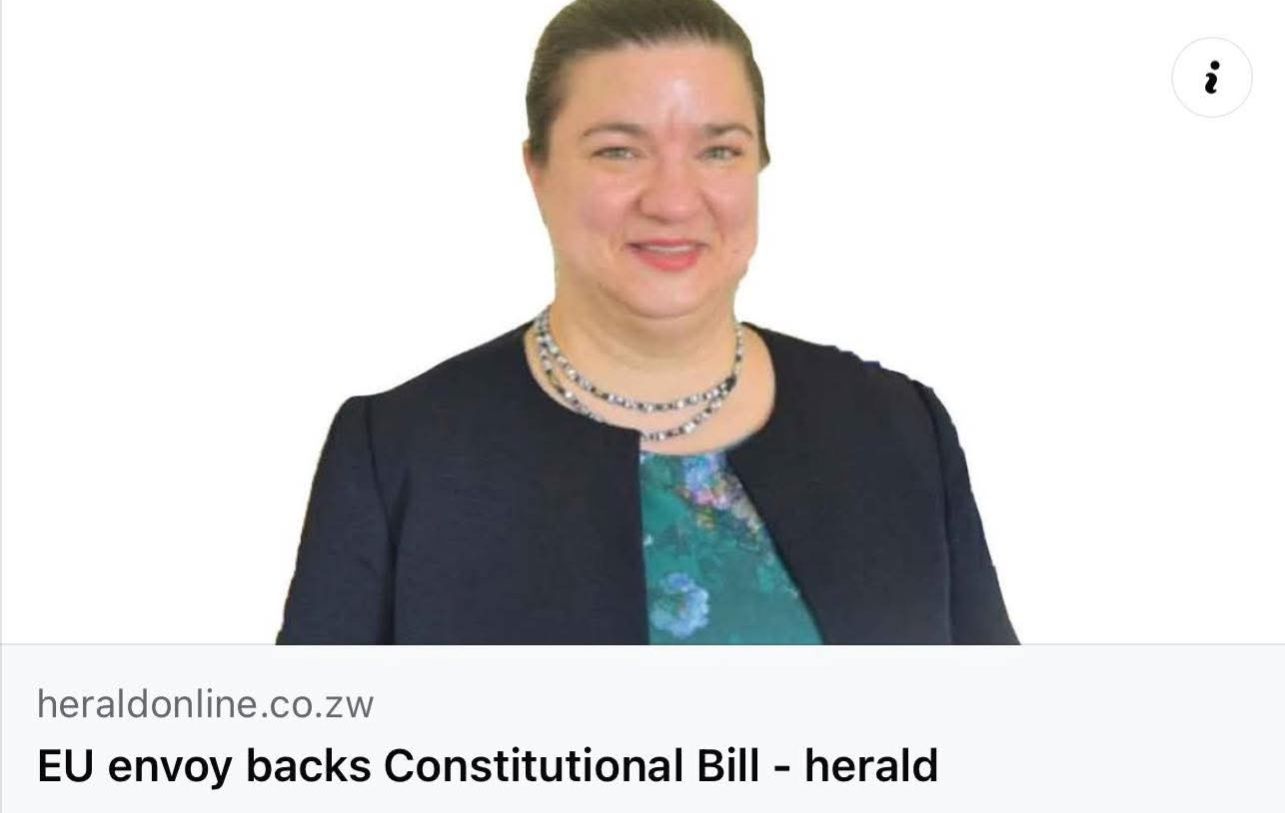
Now something interesting has happened. The European Union envoy has effectively said the same thing in diplomatic language. The very same international community that the opposition and activists was trying to sell a lie made a factually correct pronouncement on the matter.
Her words: “There are Presidential systems; there are parliamentary systems. Countries have different ways to govern themselves and it’s valid for a country to think about how one should be governed, whether five years is enough for a President, or it should be seven years, whether there should be term limits or not….We have been often very strong in pushing term limits in Africa, I come from a country where there are no term limits. Angela Merkel (former Germany Chancellor) was around for a very long time . . . it’s a perfectly valid point to discuss.”
For weeks the public debate in Zimbabwe has been framed as though any attempt to amend the Constitution is automatically a violation of the Constitution. That is not how constitutional law operates.
A constitution is not a sacred object that must never be touched. It is not. Because it did not drop from heaven foolproof. I do not understand how an entire population can believe a lie. A constitution is a legal framework that contains procedures, including the procedure by which it can change itself. If the procedure inside the Constitution is followed, then legally the Constitution is being applied, not broken.
You may strongly oppose the amendment. You may believe it is politically wrong. But political disagreement is not the same thing as a constitutional breach. This is where the current problem begins.
A large portion of the opposition leadership consists of trained lawyers. Yet the argument being advanced to the public and to the international community has been framed as though the mere act of amendment is illegal. It is not.
The legal question is much narrower than that. The real legal question, as I explained before, only arises when the amendment is designed to benefit the incumbent in conflict with section 328(7). That is the safeguard provision. That is where a genuine constitutional dispute exists. Instead, the debate has been presented internationally as if the Constitution itself is under immediate unlawful attack. The difficulty with that approach is simple.
Foreign governments and diplomats can read the Constitution themselves. They are not relying on social media interpretations. They open the document and read the provisions. When they do so, they see that the Constitution expressly allows amendment through parliamentary procedure except in specifically protected areas. Section 95 does not automatically fall into the referendum category. That is a textual fact whether one likes it or not.
This is why the EU envoy’s comments matter. Not because Europe is supporting ZANU-PF. Not because Europe is opposing the opposition. It matters because an external reader, without emotional investment in Zimbabwean politics, read the same provisions and did not see the legal catastrophe being described.
In diplomatic language she essentially indicated that the noise surrounding the issue is not moving anyone. That is the real danger. When a political argument is presented internationally as a legal crisis, but the law does not clearly support that claim, the result will shift from the intended international pressure to a loss of credibility.
The audience you are trying to persuade begins to question whether the claims are exaggerated. Worst case scenario, you convince them you are, with all due respect - dumb.
The issue in Zimbabwe has never been whether the Constitution can be amended. The Constitution clearly allows amendment. The issue is whether the amendment can lawfully benefit the sitting President in light of section 328(7). That is a clear constitutional question and it is a serious one.
By broadening the claim into allegations of a Constitution breach before that legal threshold is reached, the debate shifted away from the strongest legal argument into a general political alarm.
And political alarm is easier to ignore than a precise legal objection. And Europe that you are trying to please as puppets, is no longer impressed with empty noise - especially when it is coming parties that are led by lawyers.
You need to have the sense of mind to choose what to make noise over.
This is what many people do not realise. International actors do not respond to volume. No matter how much noise you make. That is why the US even lifted sanctions on Zimbabwe despite “disputed elections” in 2018 and 2023. They saw that you were yepping over a legitimate loss by reasonable standards.
If the legal argument is accurate and specific, it carries weight. If it is overstated, it loses force. And that is what happens.
I also listened to part of the public discussion involving Professor Jonathan Moyo on the constitutional bill together with lawyer Dr Justice Mavedzenge. Professor Moyo made several interesting political observations, but on the specific legal interpretation of term-limit provisions he was, in my view, incorrect.
The Constitution does not treat every amendment connected to tenure in the same way. The legal trigger is not simply that a provision relates to a presidential term. The trigger is whether the amendment allows the person already holding office to personally benefit from the extension of time in office. That distinction is the one that section 328(7) was designed to regulate.
Dr Mavedzenge, at least on the portion I heard, explained the definition of a “term-limit provision” more accurately. He correctly recognised that the Constitution defines such provisions broadly. And he went farther and brought case law that I wasnt aware of - to define that term. He did a splendid job.
However, even his explanation did not go the full distance. The conclusion is not that every amendment touching a term-limit provision automatically requires a referendum. It does not. The Constitution allows amendment by a two-thirds parliamentary majority in many instances.
The referendum question only arises when the amendment is structured in a way that extends the tenure of the incumbent office holder. That is the real constitutional safeguard.
What is therefore happening in the public debate is that different actors are each defending a corner of the argument but not the whole structure of the law. Some insist that any amendment is unlawful. Others suggest that a two-thirds majority settles everything. Both positions are incomplete.
A two-thirds majority is sufficient to amend section 95 for future office holders. It is not sufficient if the sitting President is intended to benefit from the extension.
This is why I even consider, although it remains a remote possibility, that the situation could politically turn in an unexpected way. Those within the ruling party who understand the law know very well that the Constitution permits amendment by two-thirds majority for future application. ED could wake up one day after 2028 and be told that that the law does not permit him to go beyond 2028, because: “we did not go to a referendum”. I hope they are not trapping him.
But if the amendment is passed and the legal effect of section 328(7) is applied strictly, the incumbent may not lawfully benefit from it. In other words, the amendment could be valid and yet not apply to the current President at all.
I do not believe the actors involved are unaware of this legal structure. The provisions are clear enough to anyone who reads them carefully.
So the EU envoy’s remarks should not be read as endorsement of government policy. They should be read as a reminder that you should read your own Constitution carefully and argue the actual legal point, not the emotional one.
The real constitutional fight in Zimbabwe has not disappeared. It has simply been misplaced.
It does not lie in whether the Constitution can be amended, but it lies on whether a referendum will be necessary or not.